
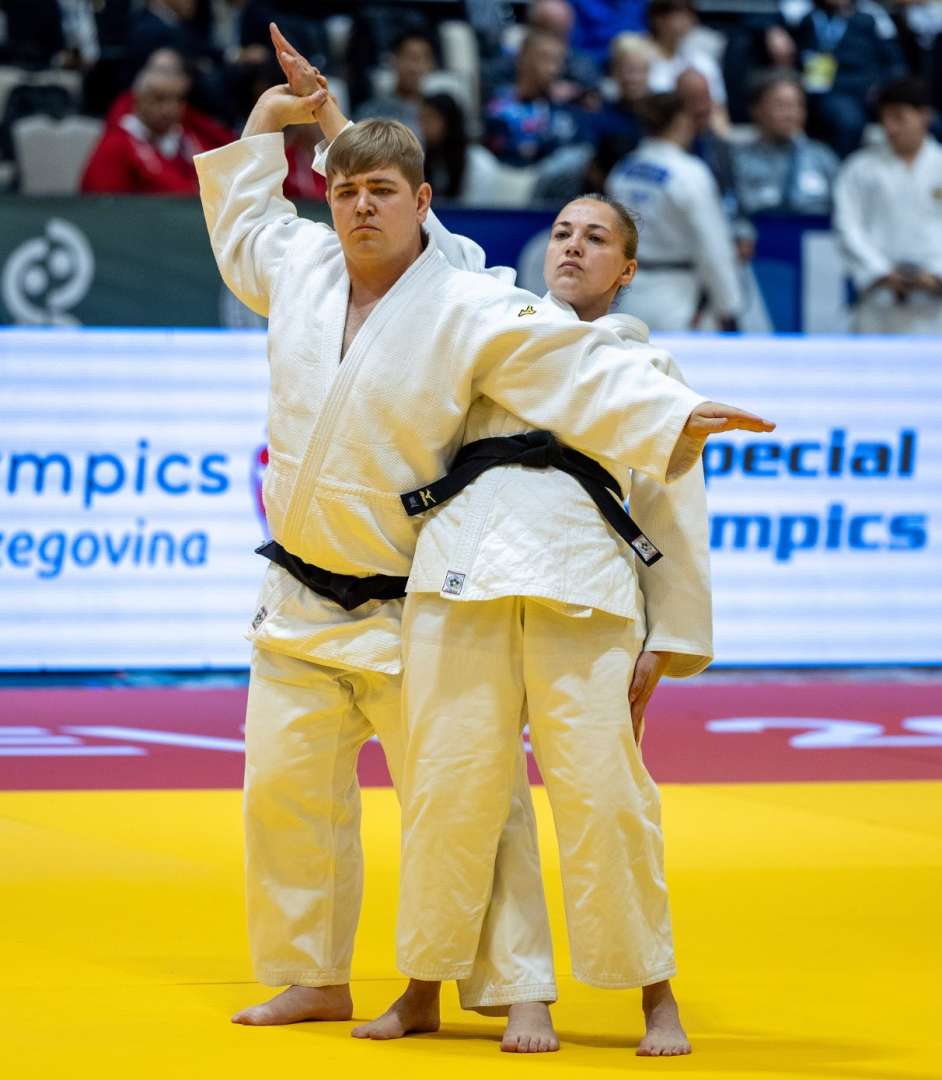
What are these flowing steps and unfamiliar movements? It is beautiful, certainly, but what is its practical purpose? Is it a kata for women? These are questions often asked. They invite a closer look at a kata that is both old and strikingly modern in the message it carries.
Ju-no-kata (柔の形) means “the form of gentleness and flexibility”. For anyone familiar with the meaning of judo, the way of flexibility, its essence is already there. Created by Jigoro Kano Shihan in 1887, only five years after the foundation of judo, Ju-no-kata gives form to the principle of ju: yielding, adapting and using the movement of the other person rather than meeting it with force. This approach can appear less visible in competition judo, but it remains at the heart of Kano’s sporting, educational, social and philosophical project.
Ju-no-kata comprises fifteen techniques, arranged in three series of five. It is performed slowly, with controlled intensity, and contains neither a completed throw nor a fall. That is not where its purpose lies. The attacks and responses are genuine in their intention, but the movement stops before the potentially dangerous conclusion of the technique. It is therefore an expressive, gymnastic composition of methods of attack and defence.
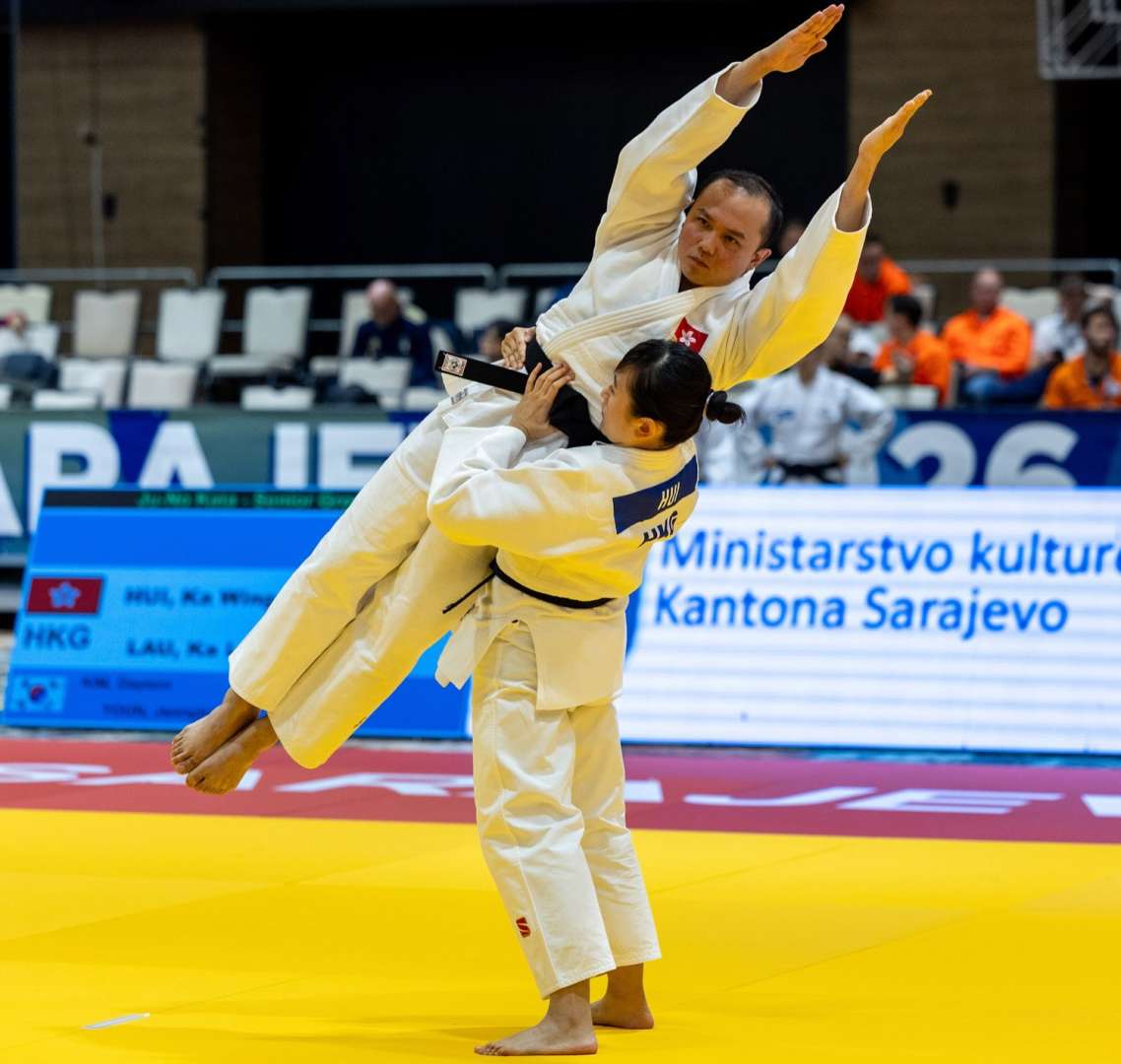
- Dai-ikkyo — first series: Tsuki-dashi, kata-oshi, ryote-dori, kata-mawashi, ago-oshi
- Dai-nikyo — second series: Kiri-oroshi, ryokata-oshi, naname-uchi, katate-dori, katate-age
- Dai-sankyo — third series: Obi-tori, mune-oshi, tsuki-age, uchi-oroshi, ryogan-tsuki
Ju-no-kata must not be reduced to a slow or decorative demonstration. It studies distance, body alignment, movement, balance, the moment when one accepts the other’s action and the moment when it is redirected. It teaches the judoka to overcome rigidity through adaptation, a principle that can be carried far beyond the tatami.
It is neither a throwing kata nor a self-defence kata. It is a particularly clear study of economy of movement: absorbing a push, diverting an attack, retaining one’s balance and making an action effective without brutality. In that sense, it gives tangible form to seiryoku zenyo, the best use of energy.
The work of tori and uke is especially close. Both partners must give the attack the right intention, preserve the continuity of the movement and avoid any theatrical effect. The difficulty is not one of speed or impact, but of precision. If distance, rhythm or body alignment are wrong, the principle of flexibility disappears.
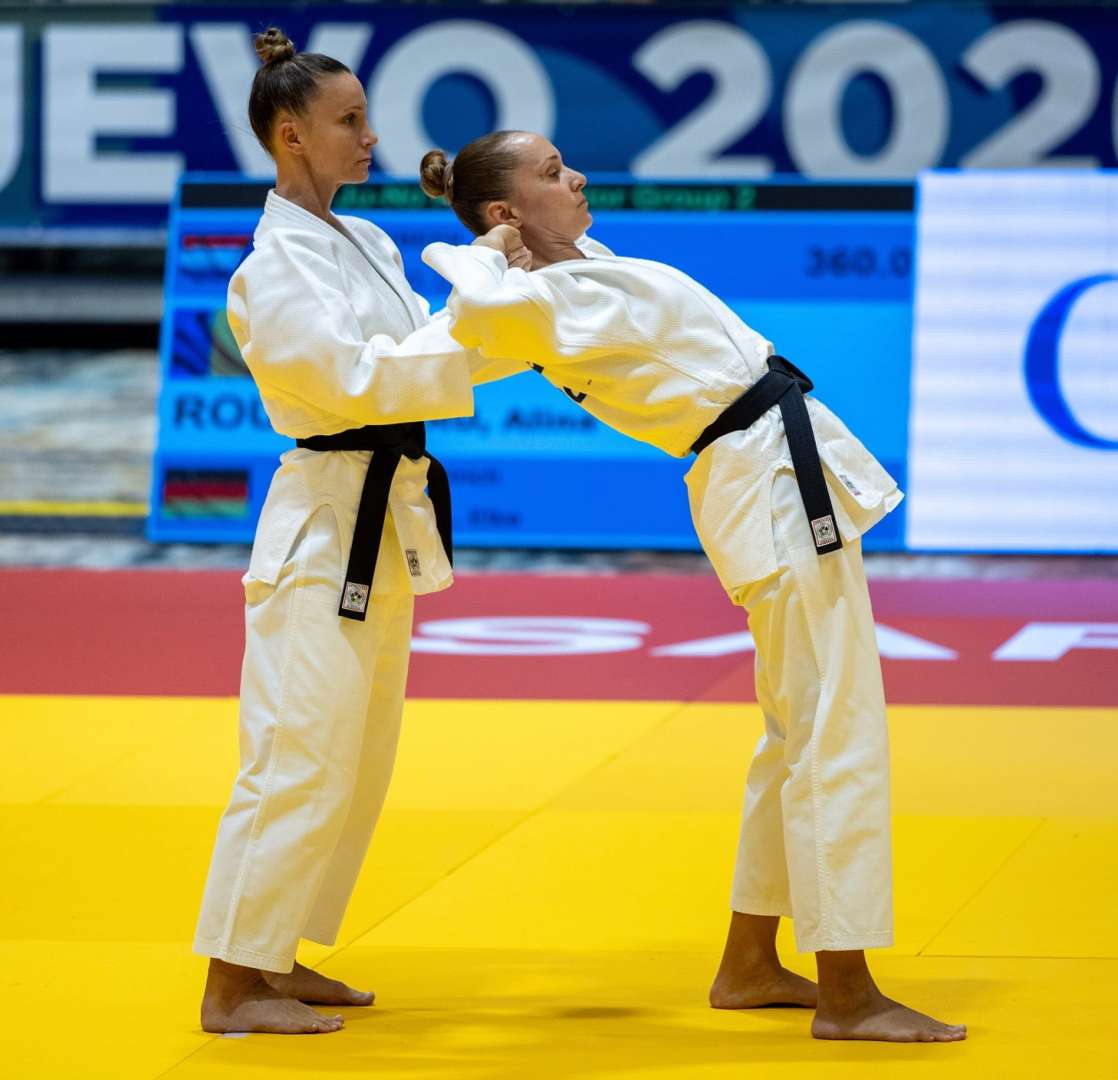
Ju-no-kata is also accessible to a wide range of practitioners, not least because it contains no falls. Contrary to a persistent assumption, it is not a kata reserved for women. The message was clear in Sarajevo: women and men are both represented, with several mixed pairs also taking to the tatami.
Ju-no-kata does not ask who is stronger. It asks whether one can understand the force that comes towards them, accept it without yielding their balance and transform it into a response that is both effective and controlled. In a world that often mistakes force for power, that remains a deeply contemporary lesson.