

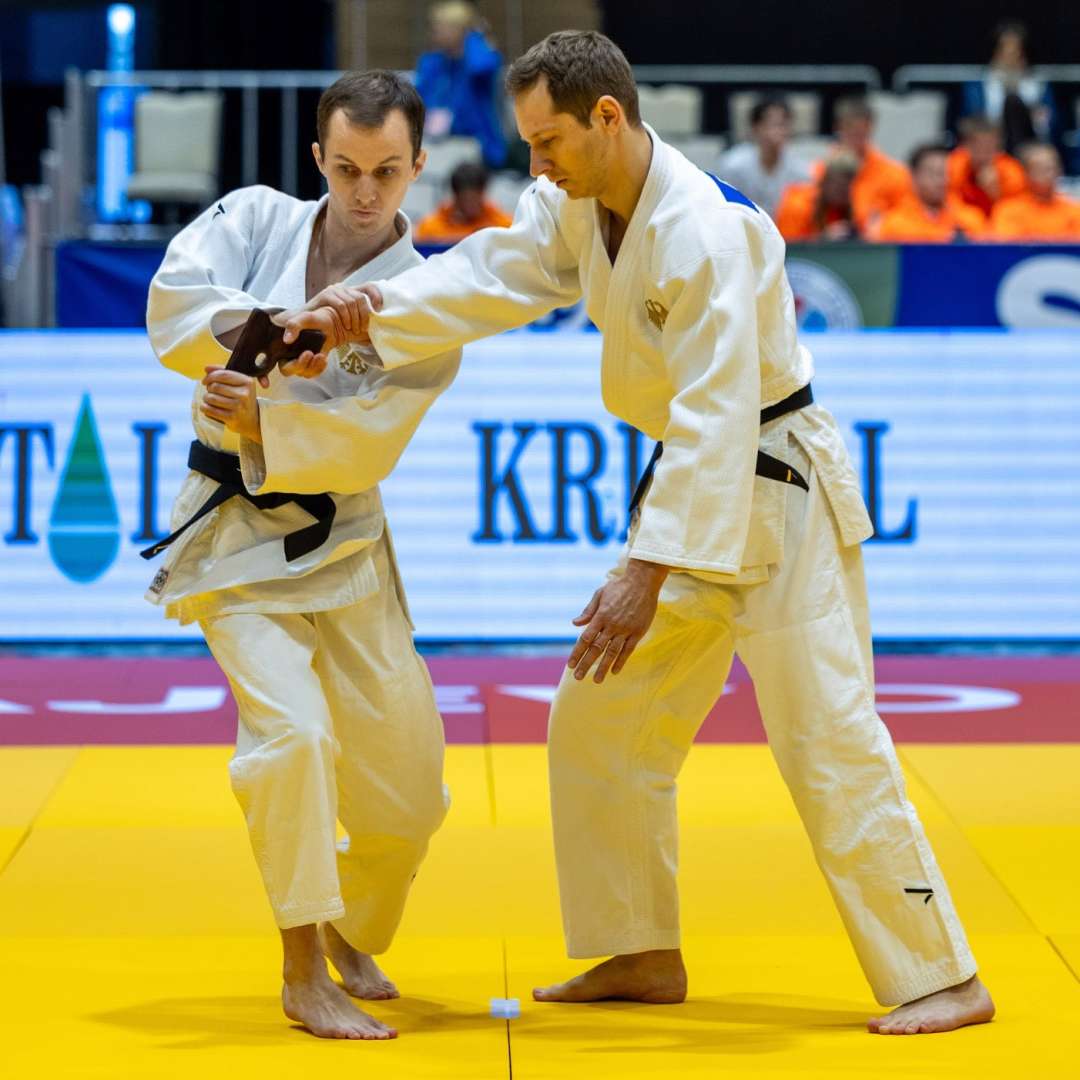
Its date of creation is revealing. Jigoro Kano Shihan died on 4th May 1938 aboard the Hikawa Maru while returning from Cairo to Japan, eighteen years before the development of this kata. Once again, this shows that judo, in all its dimensions, is not fixed in time; it evolves. Even within the more traditional world of kata, it can respond to a changing society while remaining faithful to the principles established by Kano.
Kodokan Goshin-jutsu comprises twenty-one techniques, all performed standing, in two sections:
Toshu-no-bu — unarmed section
- Holds, 7 techniques: Ryote-dori, hidari-eri-dori, migi-eri-dori, kata-ude-dori, ushiro-eri-dori, ushiro-jime, kakae-dori
- Attacks from a distance, 5 techniques: Naname-uchi, ago-tsuki, ganmen-tsuki, mae-geri, yoko-geri
Buki-no-bu — weapons section
- Against a dagger, 3 techniques: Tsukkake, choku-tsuki, naname-tsuki
- Against a staff, 3 techniques: Furi-age, furi-oroshi, morote-tsuki
- Against a pistol, 3 techniques: Shomen-zuke, koshi-gamae, haimen-zuke
Kodokan Goshin-jutsu examines the principles of defence against grips, strikes and kicks, but also against a dagger, a staff and a firearm. These are situations that appear closer to the threats of modern life than older forms. It is not, however, a mechanical instruction manual, nor a set of techniques intended to encourage confrontation outside the dojo.
The judoka remains within the codified and respectful framework of kata. Its purpose lies as much in mental discipline and the study of principles as in the technical response itself. A kata is not permission to use violence. It is a method for studying distance, awareness, restraint and responsibility.
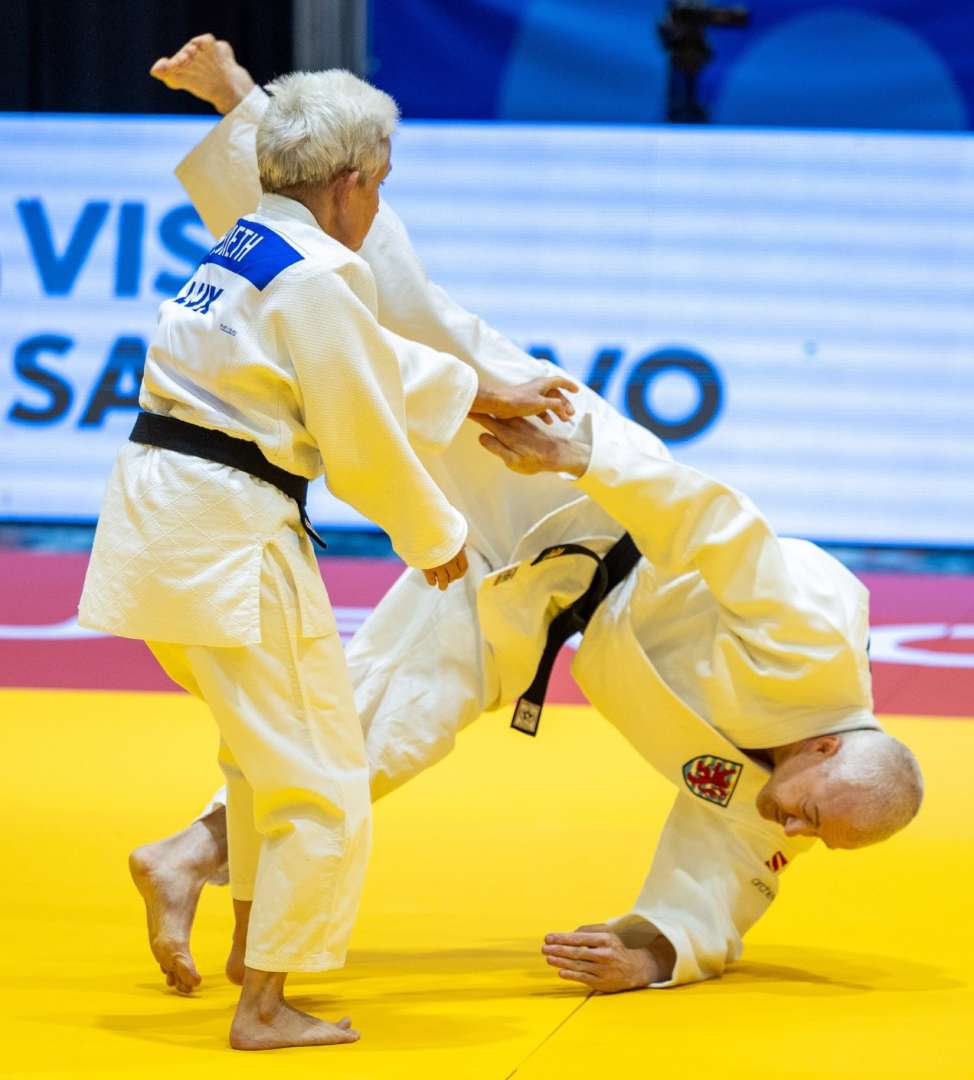
Tori must read the distance, the moment of attack, the direction of the weapon and uke’s intention, before responding with maximum efficiency and minimum risk. The work demands calm judgement, accuracy and control.
The distinction that separates it from Kime-no-kata lies is its more contemporary approach to attack. Kodokan Goshin-jutsu broadens the range of threats, notably through the presence of the stick and the pistol, while retaining the traditional relationship between tori and uke and the same requirement for precision.
Like the kata that preceded it, Kodokan Goshin-jutsu remains part of judo’s educational purpose. It uses the language of judo: movement, imbalance, throws, joint controls, strikes and evasions. Its value is to show that judo principles do not stop at competition. They can be applied to observation, prevention, correct distance and decision-making.
In this sense, Kodokan Goshin-jutsu is not a break with tradition. It is proof that tradition, when understood properly, remains capable of responding to the present.